


If you manage memberships, you’ll know it rarely feels as straightforward as it should.
On the surface, the model is simple. Members join, payments are collected, renewals happen on a set cycle. But in practice, the day-to-day reality often looks very different.
Renewal periods arrive with a mix of manual reminders, overdue follow ups and payment checks that need to be done one by one. A member forgets to update their details. Another payment doesn’t come through as expected. Someone else needs to be contacted because their renewal hasn’t been processed correctly.
Nothing is necessarily broken — but it rarely feels smooth either.
And as membership numbers grow, so does the complexity behind keeping everything moving. What starts as a manageable workflow gradually turns into a series of ongoing administrative tasks that sit across your week, every week.
Most organisations don’t notice the shift immediately. It happens slowly, as small inefficiencies begin to stack up across different parts of the process.
Eventually, managing memberships stops feeling like a structured system and starts feeling like constant coordination.
The hidden cost of manual renewals and disconnected processes
Manual renewal processes don’t tend to fail in obvious ways. They erode performance gradually, through small gaps that are easy to overlook in isolation.
A missed reminder here. A delayed follow up there. A spreadsheet updated at the end of the month because there wasn’t time earlier. A payment that needs to be manually matched. A renewal that slips through because it sat between two systems.
Individually, these moments don’t seem significant. But together, they start to shape the overall performance of your membership operation.
Revenue becomes harder to track in real time. Renewal cycles become less predictable. And retention is no longer just about member engagement. It becomes dependent on whether internal processes captured everything correctly.
There’s also a consistency problem that builds over time. When renewals rely on manual steps, the experience is rarely uniform. Timing varies. Communication varies. Follow ups vary. That inconsistency creates gaps not just in reporting, but in how reliably members move through the lifecycle.
In most cases, the challenge isn’t effort or intent. It’s fragmentation — different systems handling different parts of the same journey, without a unified flow connecting them.
And that fragmentation is what makes scaling feel harder than it should.
The shift: from payment collection to payment operations
At a certain point, most businesses realise the challenge is not simply collecting membership fees. It’s everything that surrounds it.
Renewals, reminders, failed payments, reconciliation, reporting, member updates. Individually, these feel like separate tasks. But in reality, they are all part of the same continuous workflow.
This is where a quiet but important shift happens.
Instead of thinking about payments as a transaction that needs to be collected, more organisations are starting to think in terms of payment operations — an ongoing system that manages the full lifecycle of membership revenue.
It’s a small change in language, but a meaningful change in structure.
Because once you start viewing renewals as part of an operational flow rather than an isolated billing task, the expectations change. You stop asking how to collect payments more efficiently, and start asking how the entire process can run with less manual intervention, fewer handoffs and more visibility across the full membership journey.
That shift is what separates reactive membership management from a system that can actually scale.
How automation actually works in practice
In practical terms, automation is less complex than it sounds. It is simply a structured way of ensuring that renewals, payments and member communication happen at the right time without needing manual intervention at every step.
Once a member is onboarded, their payment details are securely stored and linked to their membership cycle. From there, the system manages the renewal process automatically based on predefined rules.
As the renewal date approaches, reminders are sent out at set intervals. These don’t need to be triggered manually. They follow a consistent schedule, ensuring members are informed before their payment is due.
On the renewal date, the payment is processed automatically using the saved payment method. If the payment succeeds, the membership continues without interruption. If it fails, the system can initiate a retry process or prompt the member to update their details, without requiring someone on your team to step in immediately.
At the same time, every transaction is recorded in real time. This means reporting and reconciliation are continuously updated rather than something that needs to be manually compiled at the end of the month.
The result is a system that runs in the background, quietly handling the repetitive parts of membership management while keeping both your team and your members informed at every step.
Introducing a more modern approach to membership payments
This is where the difference between basic payment collection and a more modern membership system becomes clear.
Most traditional tools focus on taking payments. They process a transaction, record it, and move on. But membership models require more than that. They require structure around the entire lifecycle — renewals, communication, visibility, and ongoing management.
Modern payment infrastructure is built around that reality.
Platforms like MuliPay are designed to support this shift by bringing renewals, recurring payments, and operational workflows into a single system. Instead of relying on separate tools for billing, reconciliation, and reminders, everything is managed through one connected flow.
The focus is not just on collecting payments, but on reducing the manual work around them — so teams can spend less time managing renewals and more time focusing on members.
For organisations that are scaling memberships, this shift is often the difference between a process that constantly demands attention and one that runs reliably in the background as the organisation grows.
Why this matters for Australian businesses
For many Australian membership-based organisations, the pressure is not just about efficiency. It’s about scale, consistency and maintaining a reliable member experience as operations grow more complex.
Whether you’re managing a professional association, a fitness network, a community organisation or a subscription-based service, expectations have shifted. Members now expect digital-first experiences, predictable billing and the ability to manage payments without friction or manual back-and-forth.
At the same time, internal expectations have changed too. Finance and operations teams are being asked to do more with less administrative overhead, while maintaining accuracy, visibility, and control over recurring revenue.
This is where manual processes start to show their limits.
Australian merchants also operate within a landscape where transparency, reconciliation accuracy and reporting clarity matter. When payment systems are fragmented, it becomes harder to maintain a single source of truth across renewals, cash flow and member status.
Automation is not just a convenience in this context. It becomes an operational requirement for organisations that want to remain consistent, scalable, and responsive to member expectations.
And increasingly, the organisations that modernise these workflows early are the ones better positioned to grow without adding unnecessary operational complexity.
The operational mindset shift
Ultimately, improving membership renewals is not just a systems change. It’s a mindset shift.
Membership success has traditionally been measured in terms of acquisition and retention. But what sits underneath both of these is consistency — consistency in payments, consistency in communication and consistency in the member experience.
When renewal processes are manual, that consistency depends on effort. It relies on people remembering, following up and reconciling correctly every time. As the organisation grows, that model becomes harder to sustain.
When those processes are automated, consistency becomes structural. It is built into the system rather than dependent on individual execution. Renewals happen on time. Payments are processed predictably. Members move through their lifecycle without unnecessary friction. And teams gain clearer visibility without needing to piece it together manually.
This changes how organisations operate day to day.
Instead of spending time maintaining the system, teams can focus on improving it. Instead of reacting to payment issues, they can focus on member experience. And instead of managing renewals as isolated events, they can view them as part of a continuous, well-orchestrated lifecycle.
The less time you spend managing renewals manually, the more capacity you create to grow and strengthen the membership itself.
How MuliPay makes recurring payments effortless
Setting up automated payments doesn’t have to be complicated. MuliPay helps fitness studios streamline their billing process with:
- Seamless integration with your existing booking system
- Multiple payment options for customer convenience
- Automated invoicing and reminders to reduce admin work
- Secure transactions that meet Australian compliance standards
Whether you run a boutique yoga studio, a high-energy CrossFit gym or a martial arts academy, MuliPay simplifies your payments so you can focus on what matters—building a thriving fitness community.
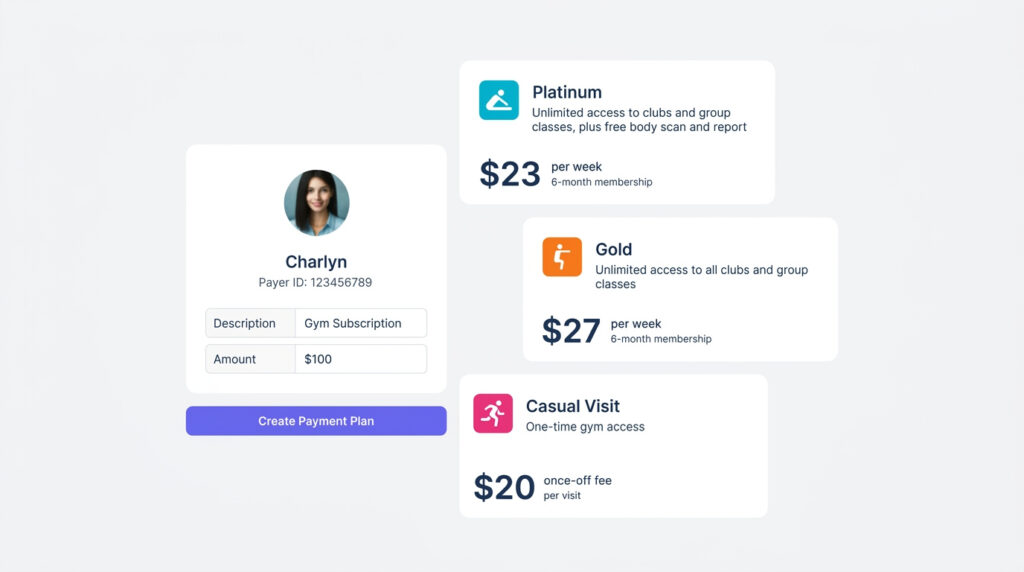
Recurring payments aren’t just about convenience—they’re about business growth. With automated billing, you:
- Reduce cancellations
- Ensure steady cash flow
- Give your members a seamless experience
The best part? It’s easier than ever to set up. Ready to future-proof your fitness studio’s payments? Explore MuliPay today and take your business to the next level.